
Brazil is bigger than most people expect. It’s a country you plan in regions, not in one trip, because flying from Rio to the Amazon takes about as long as flying from London to Cairo and that single fact should shape how you read every best places list, including this one.
The best places to travel in Brazil are Rio de Janeiro for beaches and iconic landmarks, Foz do Iguaçu for the Iguaçu Falls, Salvador for Afro-Brazilian culture, Fernando de Noronha for diving, the Amazon and Pantanal for wildlife, and Lençóis Maranhenses for its otherworldly dune-and-lagoon landscape.
Each one makes the list for a different reason, so treat what follows less like a checklist and more like a menu of very different trips: most first-time visitors build their itinerary around two or three of these regions rather than trying to cover all of Brazil at once, since the distances between them are large.
Quick guide best places to visit in Brazil at a glance:
| Destination | Known For | Best Time to Visit | Best For |
| Rio de Janeiro | Beaches, Christ the Redeemer, Sugarloaf | Dec–Mar (Apr–Jun for fewer crowds) | First-timers, city + beach combo |
| Foz do Iguaçu | Iguaçu Falls (275 individual falls) | Dec–Mar (peak water flow) | Nature lovers, Brazil–Argentina trips |
| Salvador | Afro-Brazilian culture, Pelourinho | Year-round (avoid Feb Carnival crowds if desired) | Culture and food travelers |
| Lençóis Maranhenses | White dunes with freshwater lagoons | May–Sep (lagoons full) | Photographers, off-the-beaten-path travel |
| The Amazon | Rainforest, river cruises, Manaus | May–Sep (dry season) | Wildlife and adventure travelers |
| The Pantanal | Jaguars, wetland wildlife | May–Sep (dry season) | Serious wildlife spotting |
| Fernando de Noronha | Diving, marine sanctuary | Year-round (book early; visitor caps apply) | Divers, honeymooners |
| Paraty / Ouro Preto | Colonial architecture, history | Year-round | History-focused, slower travel |
1. Rio de Janeiro: The City That Covers Every Base

If you only visit one place in Brazil, this is probably it, and not just because it’s famous. Rio is the rare destination where a rainforest hike, a mountaintop cable car ride, and a full beach day are all realistically doable within the same 48 hours.
The classic sequence is Christ the Redeemer early (before the tour buses), Sugarloaf Mountain at sunset, and then whatever’s left of the day at Copacabana or Ipanema. December through March brings Carnival energy and the warmest water, but if crowds bother you more than a few degrees of temperature, April through June is the better trade-off same beaches, a fraction of the tourists.
Also Read : latest Cities to Travel in Portugal: Top Destinations for Every Type of Traveler
2. Foz do Iguaçu: Bigger Than the Photos Suggest

Here’s what most lists don’t mention clearly enough: Iguaçu isn’t one waterfall, it’s 275 of them, spread across nearly two miles on the Brazil-Argentina border. No single photo captures the scale, which is exactly why it’s worth building an extra day into your itinerary rather than treating it as a quick stop.
The move most seasoned visitors make is seeing both sides the Brazilian side for the sweeping panoramic view, the Argentinian side for walkways that put you almost inside the spray. Pair that with Parque das Aves next door for a bird sanctuary that’s oddly one of the best hours of the whole trip. Go December to March for the falls at full power; the dry season (July–September) still looks impressive, just quieter.
3. Salvador: The Trip That Isn’t About Beaches

Skip Salvador if you want another resort town. Go if you want to understand where a huge amount of Brazilian culture the music, the food, the history actually comes from. This is Brazil’s Afro-Brazilian cultural center, in the northeastern state of Bahia, and it feels less like a stop and more like a subject you could spend a week on.
The Pelourinho district is the obvious starting point: colorful colonial buildings, live drumming that seems to follow you down every street, and acarajé (a fried black-eyed pea fritter) from a street vendor as your first real taste of Bahian food. One thing worth saying plainly, because glossing over it does readers a disservice:
Salvador has a real petty-crime reputation. That doesn’t mean avoid it it means stay in the Pelourinho and Barra neighborhoods, keep valuables out of sight, and use official transport after dark instead of walking unfamiliar streets. February’s Carnival here rivals Rio’s, so plan around it either way, depending on whether you want the crowd or want to avoid it.
4. Lençóis Maranhenses: The One Where Timing Is Everything

This is the destination that separates people who did their research from people who didn’t. Lençóis Maranhenses looks almost fake white sand dunes rolling for miles, dotted with thousands of bright blue and green freshwater lagoons but those lagoons only exist for part of the year.
Show up between roughly June and September, right after the rainy season, and you’ll find the lagoons full and swimmable. Show up in, say, February, and you may be looking at dry sand with nothing in it. That single fact makes this the one entry on this list where “best time to visit” isn’t a nice-to-know detail it’s the difference between the trip you saw in photos and a disappointing detour. Explore by 4×4 or on foot, and lean into the fact that it’s still relatively under-visited compared to Rio or Iguaçu.
5. The Amazon: Access by River, Not by Road
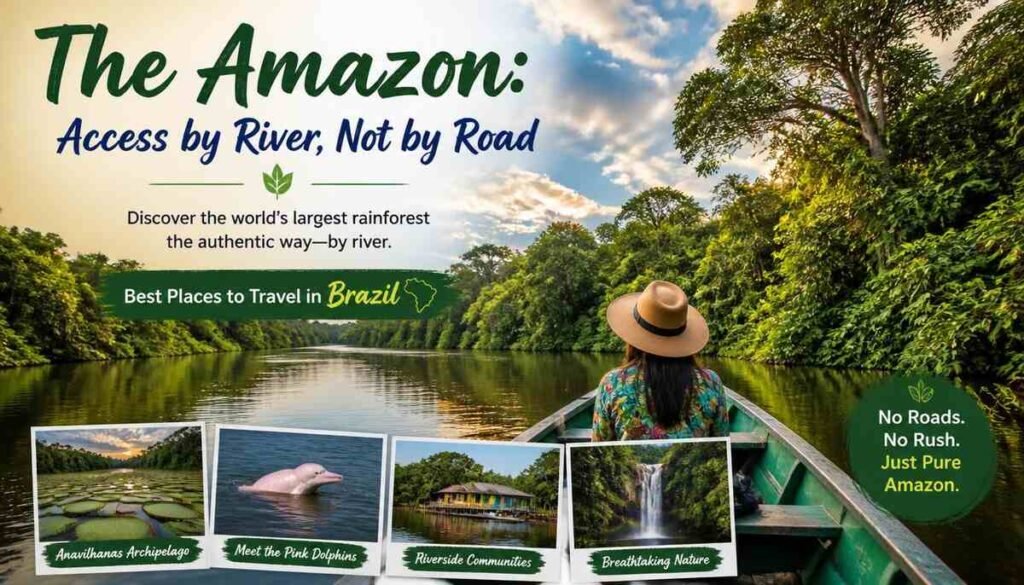
The Amazon is the most genuinely remote entry on this list, and that shapes everything about how you experience it most visits are organized around river cruises and jungle lodges out of Manaus, since roads simply don’t reach most of what’s worth seeing.
One landmark worth specifically planning for: the Meeting of the Waters, where the dark Rio Negro and the sandy-colored Amazon River run side by side for several miles without mixing. It’s a strange, genuinely photogenic phenomenon, not a marketing exaggeration. Dry season, roughly May to September, is the easier window trails are more passable and lodge access by boat is more predictable.
6. The Pantanal: Skip the Jungle, Spot the Jaguar

Here’s the counterintuitive part: if wildlife is actually the priority, the Pantanal usually beats the Amazon, not the other way around. It’s the world’s largest tropical wetland, and the open terrain makes animals far easier to spot than in dense rainforest canopy jaguars especially, alongside capybaras, caimans, and macaws.
Guided safaris by boat or 4×4 during the dry season (May–September) give you the best odds, since animals cluster around the shrinking water sources at that time of year. If a jungle photo isn’t the goal but an actual jaguar sighting is, this is the entry to prioritize over the Amazon.
7. Fernando de Noronha: Paradise, On Purpose Limited

Most destinations get crowded because they’re popular. Fernando de Noronha stays pristine because Brazil deliberately caps how many people can visit this volcanic archipelago is a protected marine sanctuary, with visitor numbers restricted and a mandatory environmental preservation fee charged on arrival.
That’s also the catch: because access is intentionally limited, prices run higher here than almost anywhere else in Brazil, and availability disappears fast around Brazilian school holidays. Snorkeling or diving alongside sea turtles and spinner dolphins in some of the clearest Atlantic water is the payoff, but this is a destination to book early rather than decide on a whim.
8. Paraty and Ouro Preto: The Slow-Travel Antidote
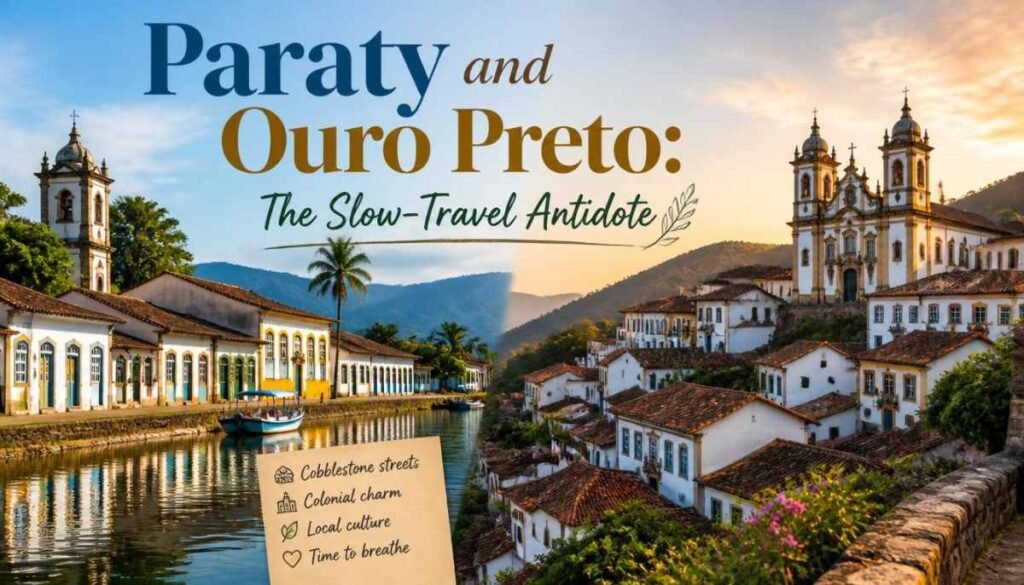
Everything else on this list moves fast waterfalls, wildlife, Carnival crowds. These two colonial towns are the deliberate counterweight. Paraty, a car-free coastal town between Rio and São Paulo, offers cobblestone streets and calm emerald water, and works well as a two- or three-day add-on rather than a standalone trip. Ouro Preto, tucked into the mountains of Minas Gerais, functions almost like an open-air museum, built on gold rush wealth and famous for lavishly gold-adorned Baroque churches.
Neither town is trying to compete with Rio’s energy, and that’s the poin they’re for travelers who want at least one slower chapter in an otherwise fast-paced Brazil trip.
Matching your travel style to a region:
| Travel Style | Recommended Region(s) | Pros | Cons |
| First-time visitor | Rio de Janeiro | Iconic sights in one city, easy to plan | Can feel touristy in peak season |
| Wildlife-focused | Amazon + Pantanal | Best animal sightings in South America | Remote, requires more planning and budget |
| Culture-focused | Salvador | Deepest cultural immersion in Brazil | Requires more safety awareness than resort areas |
| Beach/diving-focused | Fernando de Noronha | Pristine, protected marine environment | Expensive, limited availability |
| Off-the-beaten-path | Lençóis Maranhenses | Unique, less crowded, highly photogenic | Narrow visiting window (lagoons dry up outside season) |
How to Actually Plan This (Instead of Trying to See It All)
In practice, most successful Brazil itineraries pick one coastal/city base and one nature-focused region, rather than attempting a national tour. A common combination is Rio plus Iguaçu (roughly a week total), or Rio plus the Amazon or Pantanal for a more nature-heavy trip. Fernando de Noronha and Lençóis Maranhenses work best as dedicated add-ons for travelers with two weeks or more, since both require extra flights to reach.
Domestic flights inside Brazil are frequent but not cheap, and distances are genuinely continental treat this list as a menu to choose from, not a checklist to complete.
8. FAQ
Q1: When’s the best time to visit Brazil overall?
May through September — it’s dry season almost everywhere, and it’s also when the Amazon and Pantanal are easiest for spotting wildlife. Want beaches and Carnival instead? Go December to March.
Q2: Is 10 days enough for Brazil?
Enough for two regions, not the whole country. Think Rio plus Iguaçu, or Rio plus a shorter Amazon trip. Trying to do more just means more time on planes.
Q3: Is Brazil safe for tourists?
Mostly yes, in the areas travelers actually stick to. Salvador and parts of Rio do have real petty-crime risks, so stay in the known tourist zones, don’t flash valuables, and take official transport at night.
Q4: Amazon or Pantanal which one for wildlife?
Pantanal, if seeing animals is the goal. It’s open wetland, so spotting jaguars and other wildlife is genuinely easier than in dense Amazon rainforest.
Q5: Do I need a visa for Brazil?
Depends on your nationality, and the rules shift. Check Brazil’s official consulate site before booking don’t trust an old blog post on this one.

Finn Cole is a professional celebrity insider and entertainment journalist who lives for the spotlight. From breaking red carpet news to uncovering behind-the-scenes stories of your favorite stars, Finn brings you the exclusive scoop on everything Hollywood and beyond. If it’s trending, he’s already talking about it.